REVIEWS
Inexperience and other stories (UWAP, 2016)
Sydney Review of Books
“A beautifully and sensitively written insight into the modern man’s struggle to navigate a world where gender roles are opaque, and where money is – always – the ultimate signifier of value. [It] forces readers to feel the anxieties inherent in every individual’s struggle to exist as an authentic ‘self’ in a capitalist, consumer culture that depends on both promising and denying the very possibility that such a self can ever be realised.”
Text
The Australian
“Macris’s insights on sad, isolated moments of intimacy, the fraught dialogue of avoidance, are to be savoured.”
The West Australian
“This is complex and thoughtful writing that eschews the idea of a book as an experience to be conveniently enjoyed (or in many cases inconveniently endured) and instead presents a narrative that is wilfully non-conformist.”
Australian Book Review
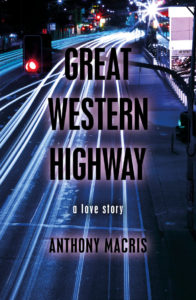
Great Western Highway (UWAP, 2012)
J.M.Coetzee (Nobel Laureate in Literature)
“[Macris] give[s] detailed and elegant descriptions of the flotsam of consumption and modern infrastructure, bringing his readers [to] really look at the objects which their daily projects push to the unfocussed periphery. Macris consolidates the stylistic achievement which made Capital Volume One such a critical success.”
Sydney Review of Books
“Macris is a psychogeographer of the urban: he reads the streets of Sydney, and particularly the unlovely section of highway that links the city with the Australian inland as a space where shifts in the way we live are most visible. … This novel marks the delayed re-emergence of a fascinating and urgent writer. Let’s hope the projected third part of Macris’s sequence doesn’t take so long to appear.”
The Australian
“Macris is a novelist who cares and thinks deeply about the world, even as he flings aside its multiple layers to criticise what he finds underneath. … Macris’s approach to novel-making offers important food for thought about what Australian political fiction should be – and should do.”
Australian Book Review
“Like [Claude] Simon, Macris is preoccupied with the vast fabric of living, with the ways in which the textures of past and present might be woven from the tiniest filaments of experience. Their shared objective is that of all serious novelists – the apprehension of reality in some unexpected or heightened or at least different way. In this regard, Macris has scored a considerable success: Great Western Highway is an ambitious, intelligent, tender and sometimes exasperating work of art.”
Jeffrey Poacher, Sydney Review of Books
Sydney Morning Herald/The Age
“Great Western Highway excels as an examination of the contradiction between the need to move on to something new and the desire to cling to something safe.”
The West Australian
“At the novel’s literal and metaphorical core is a Modernist stream-of-consciousness monologue from former UK Prime Minister Margaret Thatcher. Maggie Thatcher as free market mouthpiece – it’s an extraordinary piece of literature. … Great Western Highway is ambitious, experimental literature. It’s for this reason that UWA Publishing should be commended for taking a chance with this unconventional story of modern love.”
Verity La Magazine
“The story develops through some great dialogue, although most revealingly, through the protagonists’ inner monologues. Against the backdrop of this consumerist epoch of economic rationalism and televised wars on terror, Macris suggests societal forces that operate at a global scale also manifest at a deeply personal level. As rich in metaphors as it is, Great Western Highway rings most truly through its evocation of the most basic and real of human themes – love, and how to live a good life.”
Co-op Bookshop
“I found the intellectual ideas mesmerising, the quality of the prose outstanding and the storyline utterly engaging. What better vehicle to be flung around six lanes of inner-city traffic, up and down gutters, in and out of war zones, through ex-prime ministers’ heads and straight over the top of forgettable Hollywood thrillers than the contemporary novel? Macris puts it through its paces … A really terrific read.”
www.goodreads.com
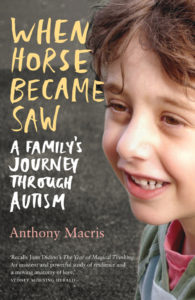
When Horse Became Saw (Penguin, 2011)
Sunday Telegraph
“When Horse Became Saw is not a handbook, but the spontaneous reaction to it is that here’s a book that can only do good. As an anatomy of a non-normal neurological condition, as a testimony to the prolonged torture imposed on a family, and as a record of love, its use is obvious.”
Australian Literary Review
“The memoir’s sharp hooks and elegant writing build its questions into an insistent and powerful study of resilience and a moving anatomy of love.”
Sydney Morning Herald
“In restrained, lyrical prose Anthony Macris records their journey through profound anguish and moments of intense joy.”
Saturday Age
“This searing, poignant memoir raises difficult questions as it charts a couple’s anguished journey through a maze of befuddling bureaucracy.”
Courier Mail
“When Horse became Saw is a heartbreaking account of the Macris family’s journey through autism. It’s a grim story, a very personal story, one that will leave you drained and angry, yet one which will fill you with hope and love at the same time.”
Canberra Times
Hobart Mercury
“Macris employs the novelist’s skill so that he not only tells the reader the facts of his experience, but invites them to live it. [He] brilliantly captures the experience of watching his son ‘drift into some strange, terrifying world’ … blending imagination, observation, science. … He effectively lobbies on behalf of all of Australia’s autistic children. Bravo to this memoir for not shutting up.”
Australian Book Review
“It’s a damning indictment of the Australian government’s meagre provisions for families with autism. Readers with autistic loved ones will be grateful for this book; it’s also an engrossing general read and a poignant story of a couple’s fierce love for their son.”
Readings Review
“No amount of well-intentioned sympathy or policy prescription could have the impact of this father’s account of what it is like to live with a child who is autistic. Anthony Macris gives voice to the unspoken sorrow and estrangement that families such as his face — slapped with the insulting inadequacy of government services, worn down by the demands of daily life, drowning in a sea of literature that brings little relief. When Horse Became Saw is vivid, devastating, realistic, yet hopeful.”
The Age
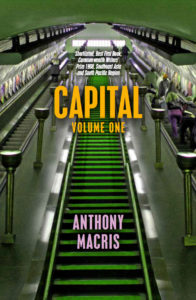
Capital, Volume One (UWAP 2013, A&U 1997)
Andrew Riemer, Sydney Morning Herald
“The most assured and interesting first novel I have encountered for years. Brisbane and Bowie, busking and bricolage, tourism and walkman, Deleuze and Guattari, converge in the London Underground in a postmodern panic.”
Don Anderson
“Macris’s first novel is rightly described as astonishing. … [O]ne finishes reading with an altered view of the world. Capital reminded me of Melville’s The Confidence Man, with its deceptively gentle wit, devastating dissection of minutiae and layering of incident towards an ominous vision. The full title of this novel is Capital, Volume One, which I suspect is a teaser or perhaps, more optimistically, a stubborn expression of faith in the face of hopelessness because Macris’s vision is acutely apocalyptic.”
Margaret Simons, The Australian’s Review of Books
“[Capital, Volume One] sets your head buzzing with the powerful kind of thinking literary art allows.”
Heat
“One of the most interesting and original novels I have read in a long while.”
The Age
await the next.”
Courier Mail
“Macris presents a subtle, yet substantive indictment of Western—capitalist—society in the late 20th century.”
Antipodes (USA)
“There is a rare skill and confidence in this novel. It obviously has to do with postmodernist tactics of irony, pastiche and self-referentiality, but all is done with unusually intelligent humour and observation.”
Australian Book Review
“[The novel is] aligned with a distinguished literary tradition […]: classically, Balzac, Flaubert, Joyce, Robbe-Grillet; more recently Bret Easton Ellis…”
UTS Review
“A rollicking giant roller-coaster of a novel.”
Campaign
ABOUT ANTHONY MACRIS
![]() |
“Great Western Highway offers a striking record of what life is like when the barriers between public and private space are everywhere giving way.”
J.M. Coetzee, Nobel Laureate in Literature
Anthony Macris is the author of the award-winning Capital novels, Capital, Volume One and Great Western Highway, which explore the ever-increasing impact of market forces on lived human experience and subjectivity. In 2023 The Cambridge Companion to the Australian Novel listed the Capital novels as major works of Australian literature. He is currently completing the third novel in the series.
His other books are: When Horse Became Saw (Viking/Penguin), a best-selling memoir about his son’s autism that was shortlisted for the Prime Minister’s Literary Awards and The Age Book of the Year; Aftershocks: selected writings and interviews; and Inexperience & Other Stories.
For most of his career he has contributed essays, reviews and feature articles to publications including The Sydney Morning Herald, The Age, The Australian, Australian Book Review, Sydney Review of Books and The Conversation. His work has been translated into French, Mandarin and Serbian. He has represented Australia at the Belgrade International Meeting of Writers, and headed the international delegation at the China Writers’ Association’s International Writing Program in Jilin, China.
Born in Brisbane to Greek migrant parents, Macris studied at the Queensland College of Art before attending the University of Sydney. He later completed an MA at Johns Hopkins University and a PhD at Western Sydney University. For more than thirty years he taught creative writing at the University of Technology Sydney, where he is now an Adjunct Professor.
Selected Essays, Articles, Book Reviews
Olga Tokarczukc’s The Empusium
(review, The Conversation)
Franz Kafka’s The Trial at 100
(review, The Conversation)
Jennifer Egan’s The Candy House
(review, The Conversation)
The Path
(personal essay, Sydney Review of Books)
394 Abercrombie Street
(personal essay, Sydney Review of Books)
8 Turner Street, Redfern
(personal essay, Sydney review of Books)
Poor Karl Ove! (Karl Ove Knausgaard‘s Some Rain Must Fall)
(review essay, Sydney Review of Books)
Don DeLillo’s Falling Man
(review, Sydney Morning Herald)
Thomas Pynchon’s Against the Day
(review, Sydney Morning Herald)
What I’m Reading
(nonfiction, Meanjin)
The Immobilized Body: Stanley Kubrick’s A Clockwork Orange
(article, Screening The Past)
NEWS
Interviewing Yoko Ono
admin2019-12-03T22:06:24+11:00November 30th, 2019|Comments Off on Interviewing Yoko Ono
Way back in 2000 I interviewed Yoko Ono for The Bulletin. She had a sculpture in the Sydney Biennale. It was an installation made up of 100 pine coffins, each with a young tree [...]
CONTACT